



”All-in-one. Saves you time so you can get back to teaching.”
You’ve heard that line so many times it barely registers.
When every platform starts to sound the same, the question in your head is: what’s actually different? Is it worth switching?
The reason they all sound the same is that they’ve all solved the same problem. After fifteen years, the original challenge — getting online, taking registrations, sending email reminders — is solved. Every platform does it. Features that save you administrative time are commoditized.
But the new problem is different.
Find‑a‑Class is more saturated than it was two years ago. Directories are more crowded. The AHA’s latest investment in provider discovery — CPR Finder — is focused entirely on an instructor‑less model. The assumption that students will always come from directories is cracking, and the last six months have made it hard to ignore.
While admin time matters, features that shave minutes off your workflow are not going to decide who’s still standing in five years. The real challenge going forward is visibility: can students who need a class actually find your business?
To solve for visibility at the platform level — not as a bolt‑on, not as a weekend SEO project — the software has to be built from the ground up for that purpose. That’s a thing almost nobody wants to talk about, because for most vendors, it means a full rebuild. And the reason new entrants don’t start there is that building the plumbing for a real CPR data model is months of quiet investment in things users can’t see — the unsexy infrastructure that drives results later.
We saw this four years ago when we started Hovn. We built for it from day one.
Can Google See Your Sneakers?
Search “white sneakers near me.” Google prioritizes stores whose systems can prove inventory: these sneakers, this size, this store, in stock right now. Buried on page three are stores with websites that talk about sneakers but whose systems can’t show Google that the sneakers are on the shelf.
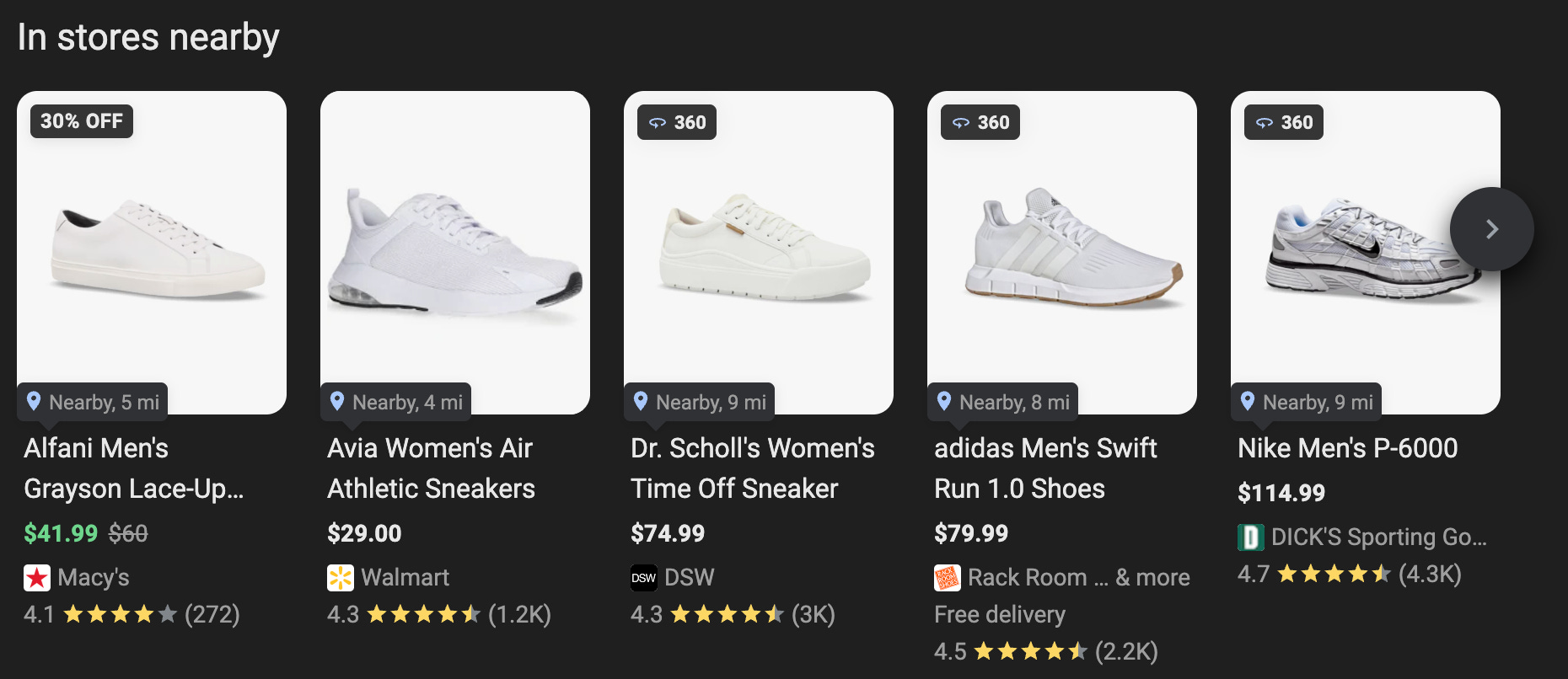
The difference is whether Google can read your catalog or just your marketing.
In CPR, your website says “We offer BLS, ACLS, PALS.” Your reviews say five stars. That tells Google you probably sell CPR classes and customers seem happy. It’s a promise.
Google wants confirmation — what it does in every other local service category — is to look at your digital shelves and verify: this provider has a BLS class on Saturday at 9am in Miami, $85, 6 seats left, certified through AHA. That’s not a promise. That’s confirmed inventory.
The technical name for this is “rich results,” which sounds like jargon. It’s simpler than it sounds. Rich results just means: can Google see and verify what you have in stock? Can it read your class catalog the way it reads a shoe store’s inventory?
Right now, in CPR, almost nobody’s catalog is visible to Google. Your platform shows a scheduling page. To you, that’s “my classes are online.” To Google, it’s close to a black box.
And that black box has a real cost measured in clicks.
With Hovn + rich results: A student searches on Google, lands directly on your session page — the exact class, date, location, and price they were looking for — and checks out.
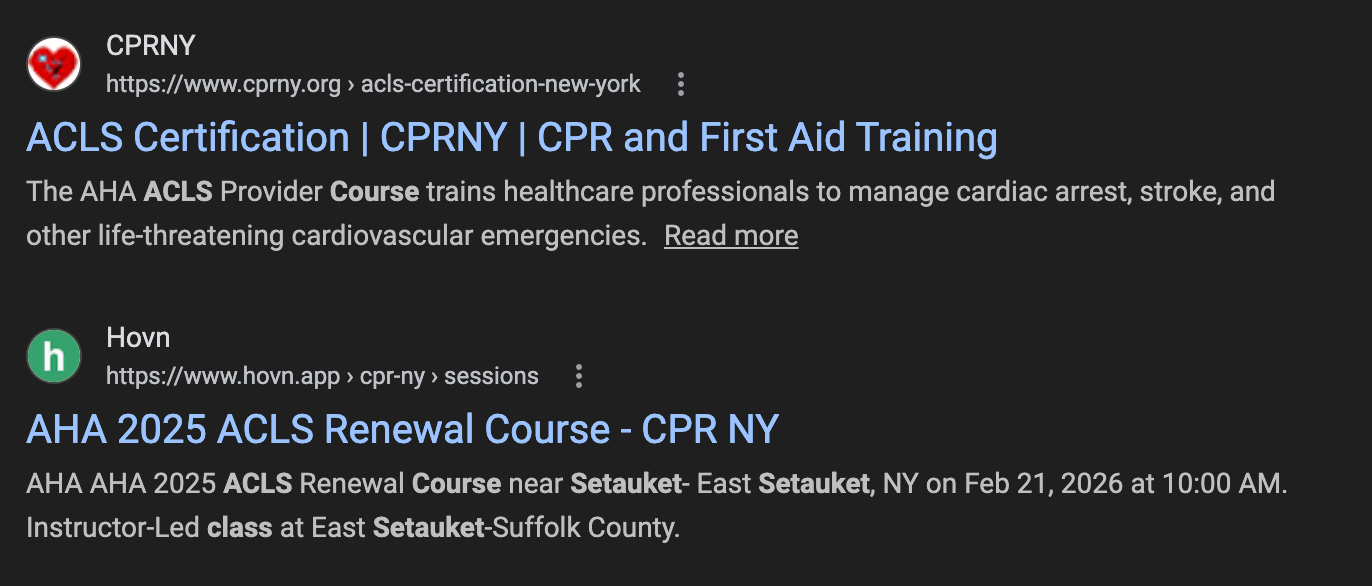
Google search, one click, your brand.
Through a directory: The student goes to an agency site, searches by location and course, scrolls through a list of providers & prices that all look the same, picks one, lands on your page (maybe), finds a session (maybe), and checks out. Six or seven clicks, competing on a tile with minimal differentiation the entire way.
Every extra click is a drop-off. Every step on someone else’s page is a step where your brand doesn’t exist. Students from a directory are the hardest students to retain.
Why Current Platforms Can’t Get You There
The platforms in this space were built as applications, not publishers. They think in registrations, text fields, and calendars. Some are now claiming to offer “class SEO” and “rich results.” But claims and infrastructure are different things.
On most of these platforms, your footprint on Google is the same whether you run 10 classes a month or 10,000:
One schedule page
No catalog depth
The largest provider on that platform looks the same to Google as a single instructor teaching a few weekend classes. The admin features they keep shipping are the only game their architecture allows them to play.
Don’t take my word for it.
Pick your top competitor or someone you aspire to be. Grab their scheduling page. Go to https://search.google.com/test/rich-results and drop it in.
Then compare it to any Hovn session page. The difference is obvious:

Saw 'No items detected'? Book a 15-minute walkthrough and we'll show you what your classes look like when Google can actually read them.
To truly solve for visibility, the platform has to treat courses, sessions, providers, locations, and certifying agencies as first‑class objects in a structured data model — real entities with real relationships, not text fields on a registration form.
If your platform is someone else’s CRM under the hood, you don’t own that model. If it was architected fifteen years ago around a single schedule view, you don’t get to proper schema and thousands of session‑level pages without rebuilding from scratch.
That’s why this isn’t a feature. For most of the market, it’s a full rewrite. Providers who’ve tried to solve this on top of their current platform have spent six figures on custom development and still maintain it by hand.
Operations = Marketing
Hovn starts from a different assumption: your operational data is your marketing.
Think about what matters when a student searches for a class. What are you offering? Where? When? At what price? Under which certifying body?
That is exactly the information you enter when you schedule a class.
So Hovn was built so the act of scheduling a class is the act of publishing it. When you create a session — pick a course, set a date, choose a location, set a price, assign a certifying agency — a dedicated listing is born on the internet. That page tells Google everything it needs: what the class is, when and where it happens, how much it costs, how many seats are left, and who’s offering it. Automatically. No SEO plugin. No separate directory listing. No third website to maintain.
As of today, Hovn has over 8,000 provider, course, and session pages with structured data, growing every time any provider schedules a class. Every class you post is one more item on your digital shelves that Google can see.
When you connect that to your Google Business Profile, your reviews tell Google “I’m a five‑star local business” and your Hovn pages tell Google “here’s exactly what I have in stock, where, and when.” That’s the combination that makes a local business show up when it matters.
Hovn acts like a megaphone for work you’re already doing. You schedule a BLS class on Friday, and the internet knows about it.
A lot of platforms call themselves “built for CPR.” Here’s what that actually requires: courses tied to real agency course identifiers. Live integrations with AHA, ARC, HSI using real data. Certifying bodies, locations, instructors, and students as actual entities in the data model — not labels on a form field. If your platform doesn’t have that structure and those integrations, it’s software with a CPR name on it.
Expense vs. Asset
This is also why most platforms price the way they do.
Platforms that process students after they’ve already found the provider live inside the provider’s existing margin. They don’t create demand. They don’t make the pie bigger. They help slice it more efficiently.
So they price like overhead: cheap monthly fee, unlimited students, stack a lot of features to justify the line item. That’s not a knock — that’s their value prop. These tools sit at the intersection of your existing margin and your tolerance for admin spend.
A platform that makes students find you sits in a different category.
Organic students who show up because Google could see your session page are high‑margin — no ad spend, no directory fee, no marketplace commission. The platform created that opportunity by existing. For our customers, an increase in organic students is revenue they didn’t have to buy and often covers the cost of the software.
The cheap tool that never creates a single incremental student is expensive. You pay cash every month and you pay again in demand you never see — searches that didn’t land on your site, students who didn’t know your class was an option, employers who found three competitors in Google before they found you once.
You can’t measure what never hit your analytics. But your bank account feels it.
The Question
For years, the way you evaluated CPR software was: does it handle my classes, my rosters, my cards? Those are table stakes now. The market solved admin.
The question going forward isn’t just “does this save me time?” It’s: is this platform putting me where high‑value students are actually looking?
If your directories get 20 or 30 percent more competitive — and the last six months suggest that’s already happening — it won’t matter how many hours your admin tool saves you. There’s no growth to optimize when the students aren’t finding you.
Hovn built the time savings. Standardized course setups, baked‑in email best practices, student portal instead of email chaos, automated reminders. The time savings are real. But the difference is that while you’re saving time, the act of running your operation is also publishing your catalog to the internet in a way Google can read.
They save time processing the students you already have. We save time and make it more likely those students find you in the first place.
—Jon
Want a second set of eyes on your operation? 15 minutes. We review your setup. You walk away knowing what to fix first.