

Legacy CPR Software Is A Filing Cabinet, Not An Operating System
How legacy platforms turn coordinators into middleware — and the hidden tax you're paying in hours, revenue, and growth—SitRep #014


If you’re a Training Center that’s been around a while, your story probably sounds like this:
“We went digital early. We use [legacy platform]. It’s not perfect, but it does the job.”
Ten years ago, it did.
It:
Took online registrations
Turned paper rosters into digital records
Helped you submit to AHA and stay compliant
For that era, it was a real edge.
The problem is that what you needed in 2015 was a filing system.
What you need in 2025 is an operating system:
Something that helps you fill seats
Grow and renew B2B accounts
And actually make more money, not just prove you did the work
Right now, your software does the filing.
Your people do everything else.
In this post:
Most TCs treat software as an expense to minimize. But software isn't a line item — it's infrastructure. It either helps you grow or caps your growth. (We wrote about that shift here.)
Filing system vs operating system
Let’s name the difference.
A filing system:
Stores registrations and rosters
Issues cards and keeps audit trails
Lets instructors “enter classes” and submit data
An operating system:
Treats students and employers as real accounts with history
Knows what classes exist, where, when, and at what price
Lets you route demand into empty seats and renew expiring staff
Most of the “all‑in‑one” CPR platforms on the market today are filing systems with calendars.
You’ve been trying to use them like an operating system and filling the gaps with people.
The ugly truth: your coordinator is the middleware
On a legacy platform, the software is not the integration layer.
Your coordinator is.
You’re in the Legacy Platform Trap if your team is routinely:
1. Living in an email‑only experience
Legacy tools will fire blended learning links automatically.
But everything still lives in email:
Access codes
Online portion links
Instructions
There’s no branded student portal. No single place to log in and see “here’s what I bought, here’s what’s next.”
Your staff spends their time:
Resending links
Answering “I never got it”
Dealing with students who show up without the online portion done
The system “sent the email.” The experience is still on you.
2. Rebuilding student and client history outside the system
“Student Search” in these platforms is really registration search:
You type “John Doe”
You get multiple rows back, one per class he’s taken
That’s not a true account. It’s a stack of receipts.
You still can’t answer cleanly:
“How many certs has John Doe gotten with us?”
“How many Acme Dental staff did we train this year, and who’s expiring next quarter?”
So you:
Export to Excel
Clean up duplicates
Manually piece together the story
The platform stores events.
You provide the narrative.
3. Doing accounting gymnastics for every reschedule
On a filing system, a simple “move this student to Thursday” really means:
Cancel original registration
Credit the balance
Re‑apply it to a new class
Make sure nothing breaks with rosters, payments, and reporting
It’s not one action. It’s a fragile little workflow someone has to remember and execute correctly every time.
4. Either overspending on custom dev… or accepting invisibility
The best way people have figured out to use their legacy platform is:
Hide the stock pages
Use it as the back‑end
Pay north of $50,000 for custom dev to build navigation and location pages on top
Then you glue everything together and keep it in sync.
If you’re not doing that, your discovery is weak.
If you are doing that, you’re paying a lot to compensate for a filing system.
There isn’t a cheap, effective middle.
5. Manually managing instructor / site data
You:
Chase instructors for updated locations, bios, and offerings
Keep separate docs or spreadsheets “just in case”
Live with a constant low‑grade fear that what’s on your site, in your platform, and in your head don’t match
The software doesn’t give you a clean, trusted network view.
You become the network view.
That’s not “it’s not perfect, but it does the job.”
That’s “we’re the job.”
When humans become the middleware, you don’t just lose time – you start paying three quiet but very real taxes inside the business: on discovery, on B2B, and on how much of your network you can actually use.
Tax 1: Discovery – invisible classes, invisible revenue
Today, students and office managers start on Google:
“BLS renewal near me”
“ACLS class [city]”
Google wants to show:
A real business,
With real inventory,
Near the searcher,
Bookable now.
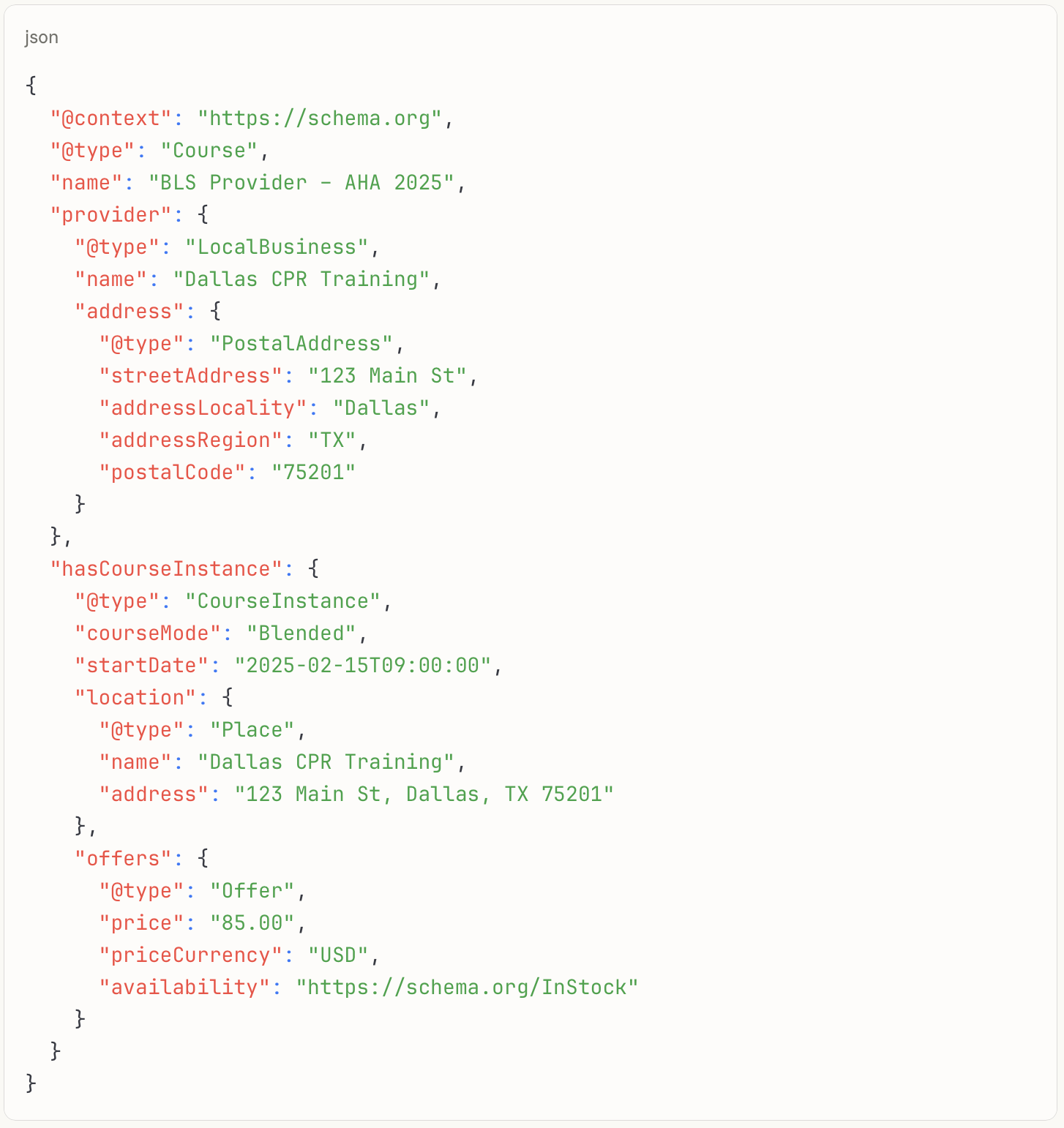
To do that, it needs machine-readable data:
Legacy platforms:
Treat course and location as free‑text fields
Don’t emit proper structured data on their own
Don’t auto‑generate SEO‑friendly “course × city × date × location” pages
So you’re stuck with a fork in the road:
Option A: Spend big on custom dev.
Use the platform purely as a back‑end
Pay a dev team to build all your class and location pages, filters, and URLs on top
Maintain that layer forever as things change
Option B: Don’t.
Accept that your schedule is basically invisible to search
Rely on directories and word of mouth to keep seats full
Either you spend a lot to duct‑tape growth on top, or you accept that the system you pay for can’t pull its weight in discovery.
An operating system should:
Automatically generate clean, linkable pages for course × city × date × location
Attach the right schema so Google understands what you offer
Keep those URLs and inventories up to date from the system of record
You shouldn’t have to hire a software developer just to show up where your buyers are.
Tax 2: B2B – your best growth lever, throttled by fields and exports
In legacy systems, employers exist as values in a field, not as first‑class accounts.
That means B2B looks like this:
Run a report
Filter by company / code / notes
Export to Excel
Build a billing sheet
Create an invoice and attach rosters
Chase payment 30–60 days later
Every. Single. Month.
And that’s before you:
Answer “who did we train at Acme Dental this year?”
Figure out who at Acme expires next quarter
Try to proactively propose a renewal plan instead of waiting for them to call you
Realistically, for a serious TC, that’s easily 4+ hours per employer per month between:
Reports
Fixing errors
Emails and calls
Invoices and collections
With just 15 solid employer accounts, that’s:
60+ coordinator hours every month
Time that could be spent creating new B2B relationships instead of servicing them
And B2B is one of your strongest growth levers:
Higher ticket
More predictable
Easier to renew
But your filing system makes it feel like a chore, not a strategy.
An operating system treats “Acme Dental” as an account:
You click once and see 42 staff, what they took, and who expires when
You can filter “employers with 5+ staff expiring in the next 90 days”
You can send renewals or schedule private classes in minutes, not afternoons
Same employers. Same staff.
Very different ability to grow that line of business.
Tax 3: Network power – a network you can’t actually use
On paper, your network is your advantage.
In software, it’s an afterthought.
Instructors and sites use the platform to:
Post classes (sometimes)
Enter rosters
Pay you for cards
Data and money flow up.
Almost nothing flows down:
Students can’t easily discover providers across your footprint
Employers can’t see “locations near our offices”
You can’t quickly route a student or B2B opportunity into an under‑filled class
Even when vendors tease APIs it still assumes:
You’ll do the work to design the views
Or pay a developer to build and maintain them
When I ask, “Can you see who’s teaching BLS this Friday in [metro]?” most owners say yes.
What they mean is:
“If you give me a minute to run a report and clean it up, I can probably figure it out.”
That’s not network view. That’s network guessing.
Where we’re going with Hovn:
The system already understands course, city, date, location, and agency
It can automatically generate the concatenated URLs and pages behind those combinations
Network‑level visibility and promotion become things you get out of the box, not custom projects you have to manage
You shouldn’t need to be a software architect to use your own network.
Why this gets worse the more successful you are
At 500 students a year, the pain is annoying.
At 5,000+, it’s a cap.
Every new:
Site
Instructor
Employer
Guideline change
…doesn’t plug into a smarter system.
It just increases:
The number of reports you run
The spreadsheets you maintain
The “give me a second” moments when someone asks a simple question
Growth should mean: more output for the same ops.
On a filing system, it means: more ops to support the same output.
The market is consolidating. (We wrote about that here.) If your software can’t produce clean student records, help you fill seats, or prove retention — you’re not just inefficient. You’re less valuable.
What an operating system lets you do instead (and where Hovn fits)
A real operating system for your training business:
Treats students and employers as accounts, not just rows on rosters
Treats classes as structured inventory: course, city, date, time, location, price, agency
Branded portals instead of email‑only experiences
SEO‑optimized class and location pages generated from the system of record
Gives you a clean view of employer staff, status, and renewals
Reduces the glue work around blended, rosters, and renewals
Same staff. Smarter ops. More growth.
One small next step
Yes, migration is real work.
That’s exactly why most centers stay where they are.
So don’t commit to “switching platforms.”
Just see your own numbers and design a low‑risk test.
If you read this and thought, “This is exactly how we’re operating,” take 30 seconds and click the button below:
In 20 minutes, we’ll:
Map your current setup (tools, workflows, B2B)
Put rough numbers on the Legacy Tax you’re paying in time and missed revenue
If it makes sense, sketch a simple, one‑class pilot so you can see Hovn run a real class end‑to‑end alongside your current system
You’ll leave with a simple comparison:
Keep the filing system
vs
Run a pilot on an operating system
If the pilot and the math say “change,” great.
If they don’t, at least you’ll know you’re not crazy for feeling like your team has become middleware.
Jon
This is Part 1 in the software trap series: Card Mills are a Symptom, Not the Disease.